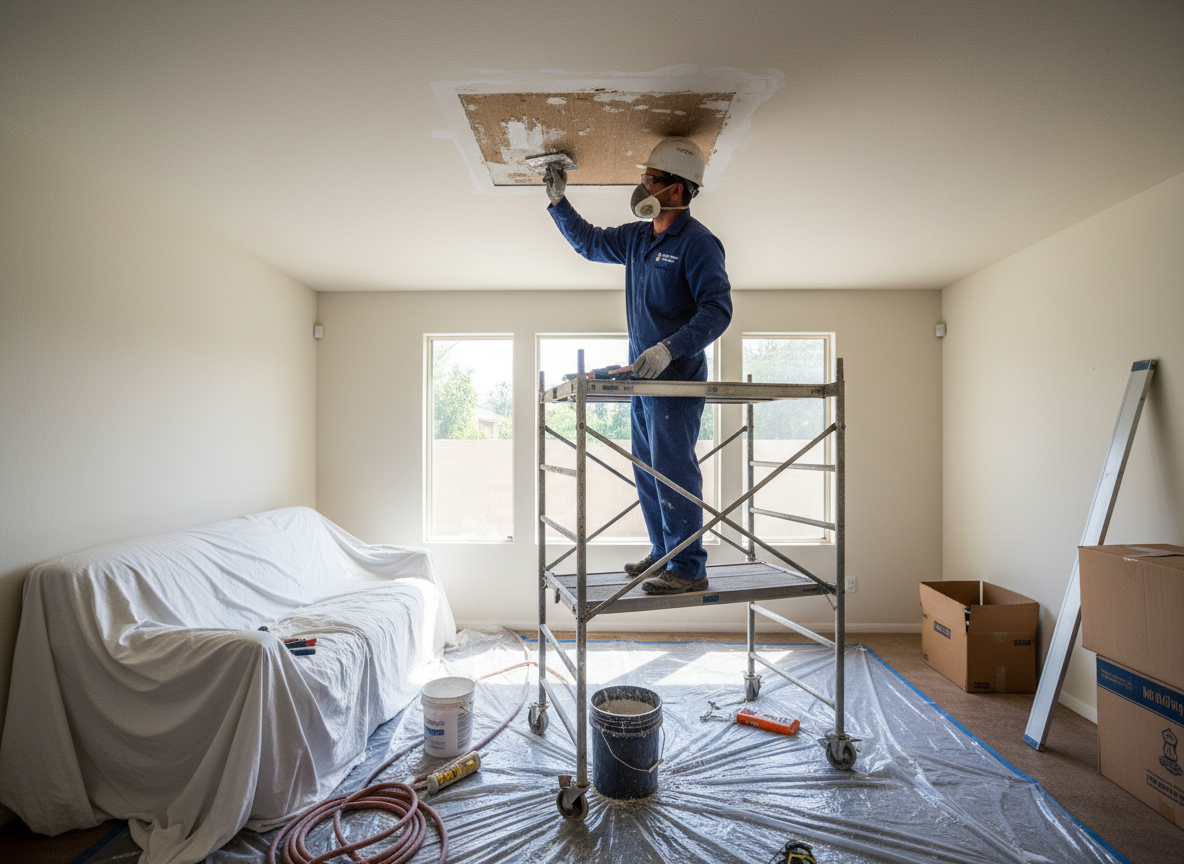
Ceiling leaks in East Irvine often trace to aging roof penetrations or supply lines in homes built during the 1970s and 1980s expansion. Drywall ceilings with textured finishes absorb moisture quickly, allowing water to travel laterally along joists before any visible staining appears on the surface. Technicians must trace the full migration path using moisture meters rather than relying on obvious marks, then remove and replace saturated sections to prevent hidden mold growth in the warm, dry summers typical of Orange County.
When a leak originates from an upstairs bathroom or kitchen, the repair involves isolating the affected ceiling plane without disturbing adjacent rooms. In East Irvine tract homes, shared attic spaces and minimal insulation can let water reach multiple units, so containment barriers and negative air machines are set up immediately. Replacement materials must match the original texture and thickness to satisfy HOA standards common in the area, and all new seams receive proper tape and compound to avoid telegraphing cracks later.
After drying, the ceiling is inspected for structural sag in the drywall or compromised joists, especially in single-story ranch styles prevalent along Irvine Boulevard. Any electrical wiring that has been exposed to water is tested and replaced as needed before the surface is refinished. Homeowners are advised to monitor the repaired area during the first winter rains, as residual moisture can reappear weeks after the initial event if the source was not fully addressed.
Seasonal Guidance
Winter storms bring the majority of ceiling leaks in East Irvine; checking attic access points before the rainy season reduces emergency calls. Summer heat can mask slow leaks until they become major.
Common Confusion Points
Homeowners often mistake condensation from HVAC ducts for true leaks; a moisture meter distinguishes the two without unnecessary demolition.
Technician insight
In East Irvine, the thing that catches most people out with Ceiling Leak Repair is how 1980s tract homes with flat roof sections and popcorn ceilings let water travel ten feet or more along the joists before any stain shows up downstairs.
East Irvine Home After Winter Rain
A homeowner noticed a faint brown line on the living room ceiling two days after a storm. Inspection found a cracked vent boot on the roof allowing water into the attic insulation. The saturated section was opened, dried, and replaced with matching texture; the roof boot was sealed the same day. No further staining appeared during the following rains.
How it works
- 1
Initial Inspection
Technician arrives within hours, uses moisture meters and thermal imaging to map the full extent of water migration through the ceiling assembly.
- 2
Source Identification
Roof, plumbing, or HVAC lines are examined from the attic or above to locate the entry point without guessing.
- 3
Drying and Containment
Water is extracted, affected drywall sections are removed, and drying equipment runs until readings return to normal.
- 4
Repair and Finish
New drywall is installed, textured to match, primed, and painted; surrounding areas are cleaned and restored.
Pricing
Upfront quotes provided after on-site inspection; cost varies with extent of hidden damage and access difficulty.