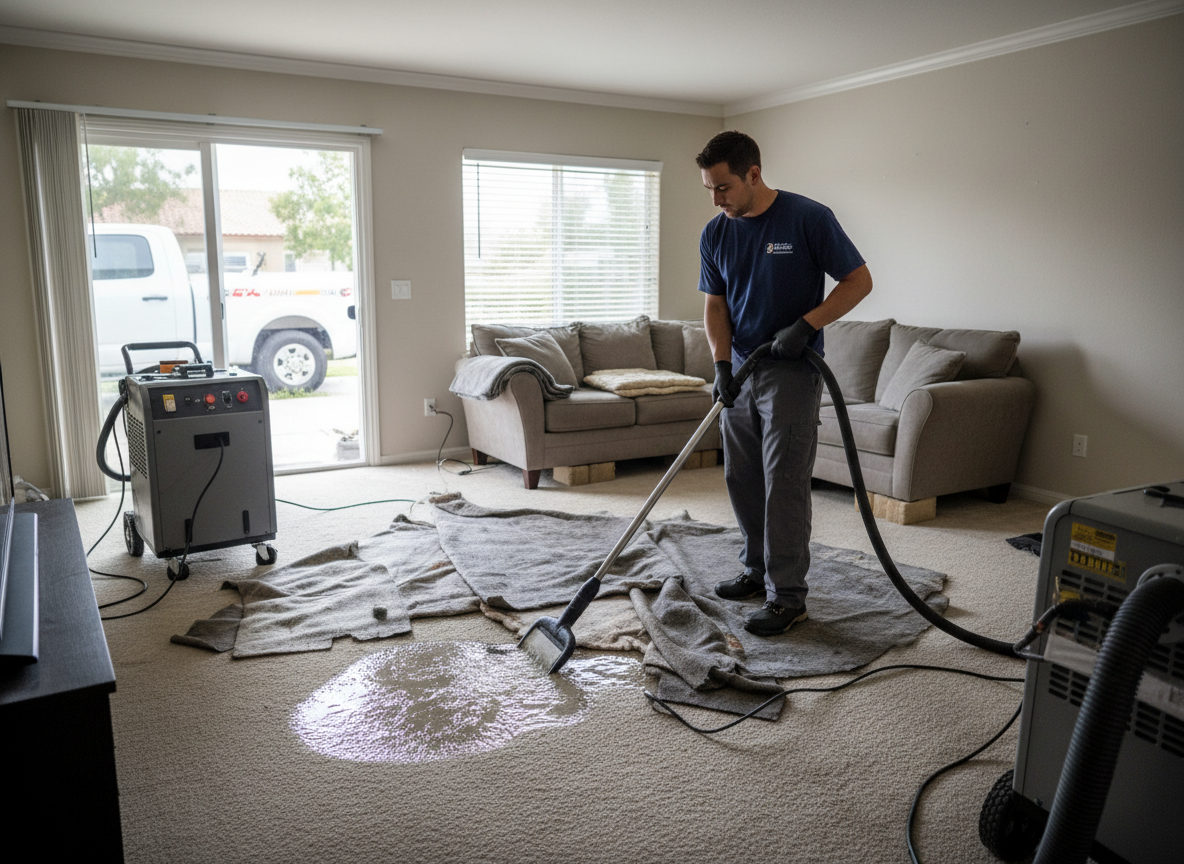
East Irvine homes built from the 1970s onward often feature wall-to-wall carpet over concrete slabs. When water from appliance leaks or winter storms enters, it travels quickly beneath the padding and along expansion joints. Technicians must lift carpet edges, remove saturated underlayment, and use moisture meters to check subfloor dryness before reinstallation. Skipping these steps leaves residual moisture that leads to musty odors and mold within days.
Flat terrain around Irvine Boulevard and nearby residential tracts allows water to pool rather than drain away. Older carpet installations with jute backing absorb more water than modern synthetics, increasing drying time. Crews use industrial air movers and dehumidifiers sized for the square footage while monitoring humidity levels to avoid warping baseboards or affecting adjacent hardwood. Homeowners who attempt DIY drying with household fans frequently miss the slab interface where moisture lingers.
After extraction, antimicrobial treatment is applied only where visible staining or sewage involvement exists. Padding is replaced with new material matched to the original thickness, and carpet is re-stretched using power stretchers to eliminate wrinkles. Final inspection includes checking under nearby cabinets and toe-kicks where water can wick unseen. This process restores the carpet without full replacement in most non-sewage cases common to East Irvine residences.
Technician insight
In East Irvine, the thing that catches most people out with Carpet Water Damage Restoration is how water travels under the padding along the slab joints common in homes along Irvine Blvd; homeowners often dry only the surface and miss the concrete interface where mold starts within 48 hours.
Supply line leak under living room carpet
A homeowner near 6424 Irvine Blvd reported a sudden leak that soaked carpet in a 1970s slab home. Inspection showed water had wicked into the padding and reached the slab edge. Extraction, padding replacement, and targeted drying prevented hidden mold growth. The carpet was cleaned and reinstalled without replacement.
How it works
- 1
On-site assessment
Technician arrives within hours, maps water migration using moisture meters, and identifies affected carpet sections and any hidden slab moisture.
- 2
Water extraction
Portable and truck-mounted equipment removes standing water and pulls moisture from carpet fibers and padding.
- 3
Padding removal and drying
Saturated underlayment is discarded, carpet is lifted, and high-velocity air movers plus dehumidifiers dry the slab and backing.
- 4
Cleaning and reinstallation
Carpet is cleaned, treated if needed, new padding installed, and carpet re-stretched to original condition.
Pricing
Cost depends on affected square footage, water category, and whether padding replacement or subfloor drying is required; upfront quotes provided on site.